
Real estate closings don’t leave much room for inconsistency.
The process is structured long before notarization even begins. Documents are prepared in batches. Multiple parties are involved. Timelines are tied to financing, approvals, and scheduled transfers.
Everything depends on coordination. That’s why notarization in this context is not just a final step. It’s part of a chain that needs to hold together without interruption. When it doesn’t, the impact shows up immediately.
A delay in one document affects the rest. A mistake forces a correction that pushes the timeline. A session that doesn’t move smoothly creates pressure across everyone involved. And unlike simpler use cases, there’s very little flexibility to absorb those issues.
Real Estate Workflows Are Structured for a Reason
In most industries, processes can adapt as they go. Real estate doesn’t work like that.
The order of actions matters. The documents follow a defined sequence. Each step depends on the previous one being completed correctly.
That includes:
- Loan documents that must be signed in a specific order
- Title-related paperwork that requires precise verification
- Multiple signers who may join from different locations
- Strict timelines that don’t allow for repeated delays
The notarization layer has to fit into that structure without disrupting it. If it doesn’t, the process starts to slow down in ways that are difficult to recover from.
The Issue Is Not Capability, It’s Alignment
Most online notary platforms can handle real estate documents. That’s not the challenge. The challenge is whether the platform aligns with how these workflows actually function. A mismatch doesn’t look dramatic at first. It shows up in smaller ways.
A document flow that doesn’t match how closings are structured. A session that doesn’t handle multiple participants cleanly. A process that requires extra coordination instead of reducing it.
Over time, those gaps become part of the workflow. And once that happens, the platform is no longer supporting the process. It’s something the process has to work around.
What Real Estate Teams Actually Need
At this level, the requirements become more specific. Not just speed or availability, but how the system behaves under real conditions.
What tends to matter in practice:
- Sessions start without delays when multiple parties are involved
- Documents are handled in the correct order without manual adjustment
- Participants can move through the process without stopping to clarify steps
- The system supports compliance without adding extra friction
- The process remains stable across repeated closings
That combination is what keeps closings moving.
1. OneNotary
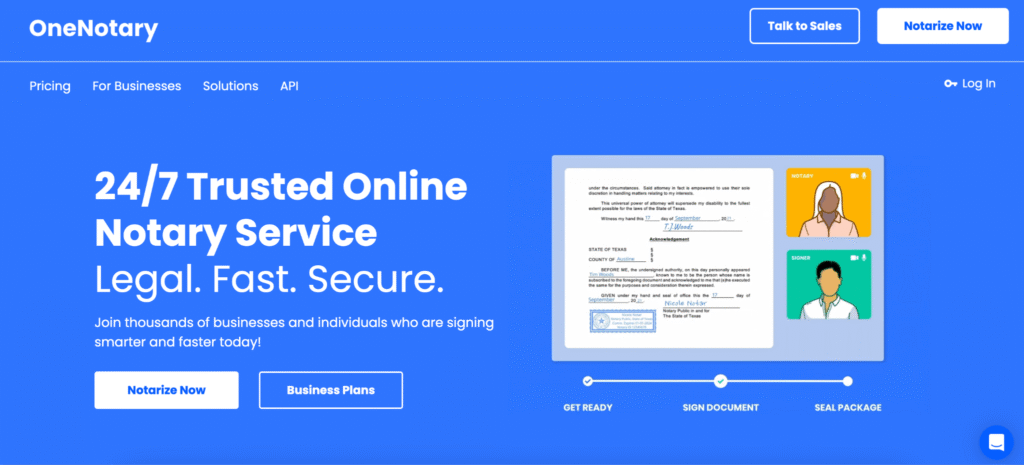
OneNotary is structured in a way that fits directly into real estate and title workflows, where document accuracy and timing are closely connected.
The platform guides the session step by step, which helps reduce hesitation during multi-document closings. Instead of requiring participants to interpret the process, it follows a defined sequence that keeps things moving.
That becomes especially important in mortgage closings, where documents must be completed in a specific order and without errors.
What supports real estate workflows:
- Sessions connect quickly to a notary, reducing delays at the start
- Documents go through verification before the session, which helps prevent corrections mid-closing
- Guided flow keeps multiple participants aligned throughout the process
- AI-assisted document handling improves accuracy across large document sets
The structure helps keep the closing on track without relying on manual coordination at every step.
2. NotaryCam
NotaryCam is often used in real estate transactions that involve more complex coordination.
Closings can include multiple parties, cross-state or international participants, and document packages that require careful handling. The platform supports that level of detail without simplifying the process too much.
This becomes relevant in transactions where the structure cannot be adjusted.
What it handles well:
- Support for real estate documents such as deeds, mortgage agreements, and title transfers
- Ability to manage multi-party sessions with different joining times
- Secure video-based notarization that allows remote participation across locations
- Workflows that account for more detailed verification requirements
The process reflects the complexity of the transaction rather than forcing it into a simplified format.
3. Notarize (Proof.com)
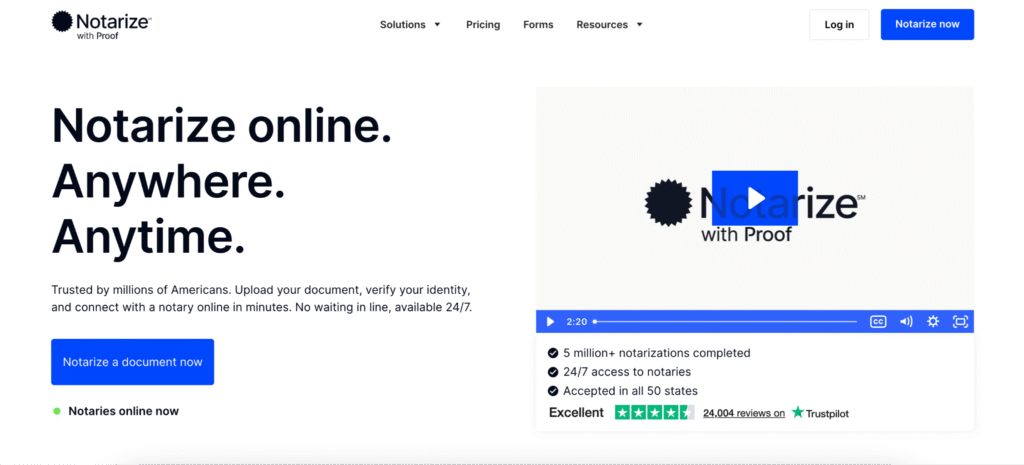
Notarize is widely used in real estate transactions, particularly in mortgage-related workflows.
The platform is built around a consistent process that repeats reliably across different closings. That consistency becomes important when teams are handling multiple transactions at the same time.
It allows closings to follow a familiar pattern, which reduces the need for additional explanation or adjustment.
What supports real estate use:
- 24/7 access to notaries helps accommodate different closing schedules
- Sessions follow a structured flow that remains consistent across transactions
- Support for multi-signer sessions allows all parties to complete their parts
- Document handling integrates with signing workflows, keeping the process connected
That stability makes it easier to manage volume without introducing variation between closings.
4. DocuSign Notary
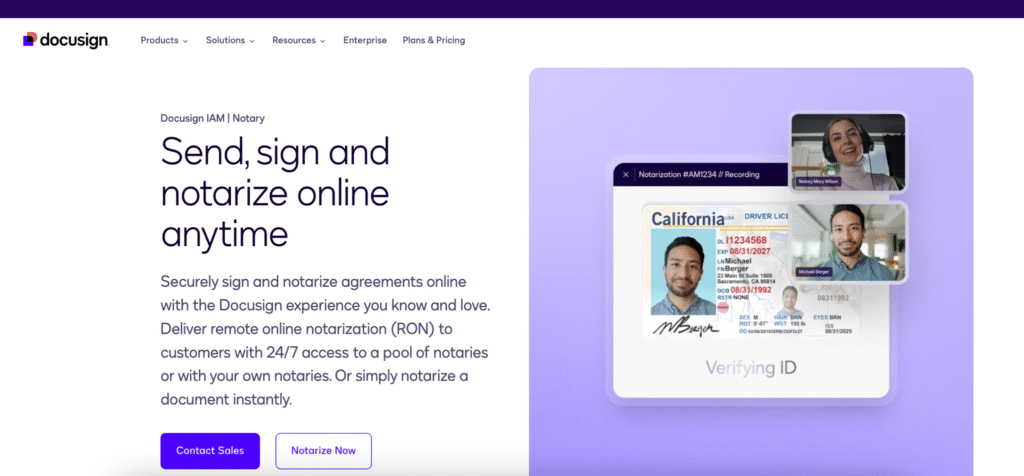
DocuSign Notary is often used in real estate environments where document signing is already part of the DocuSign ecosystem.
Instead of separating signing and notarization, both happen within the same system. That removes a layer of transition that can slow down closings when multiple documents are involved.
The result is a more continuous process.
What that changes:
- Documents move directly from signing to notarization
- Participants stay in a familiar interface throughout the session
- Notarization becomes part of the existing document workflow
- Teams don’t need to coordinate between separate tools
This setup works well in environments where efficiency depends on keeping everything within one system.
Where Real Estate Closings Usually Break Down
The issues are rarely obvious. They show up in transitions.
Moving from one document to the next takes longer than expected. A participant pauses because the next step isn’t clear. A document needs to be corrected in the middle of the session.
Each interruption creates a small gap. And in a closing, those gaps are what slow everything down. Not because the process is broken, but because it no longer moves as a continuous sequence.
Why Structure Matters More Than Flexibility
In many products, flexibility is seen as an advantage. In real estate workflows, structure tends to matter more.
The process is already defined. Documents follow a specific order. Participants have clear roles. There isn’t much room to improvise.
A system that introduces variation creates more work, not less. That’s why platforms that follow a consistent structure tend to perform better in this context. They don’t require the team to adjust the process every time.
Where AI Actually Helps in Closings
AI becomes useful in real estate workflows when it reduces the need for corrections. Not during the session, but before it begins.
In practice, that includes:
- Identifying missing fields in loan or title documents
- Preparing document packages so they are ready for signing
- Reducing errors that would otherwise interrupt the closing
- Improving document handling across repeated transactions
These adjustments don’t change how the process looks. They reduce the number of interruptions that would otherwise slow it down.
What Keeps Closings Moving
A closing works when the process doesn’t require constant attention.
Participants move through their steps without stopping. Documents don’t need to be revisited. The session progresses without someone having to manage every transition manually.
That doesn’t come from adding more features. It comes from having a structure that holds everything together.
When the Workflow Starts Feeling Stable
At some point, the difference becomes clear. In one case, the closing feels like a sequence that continues on its own. In another, it feels like something that needs to be managed at every step.
The tools may offer similar capabilities. But the way the process behaves is different. And in real estate and title workflows, that difference shows up almost immediately once the closing begins.